
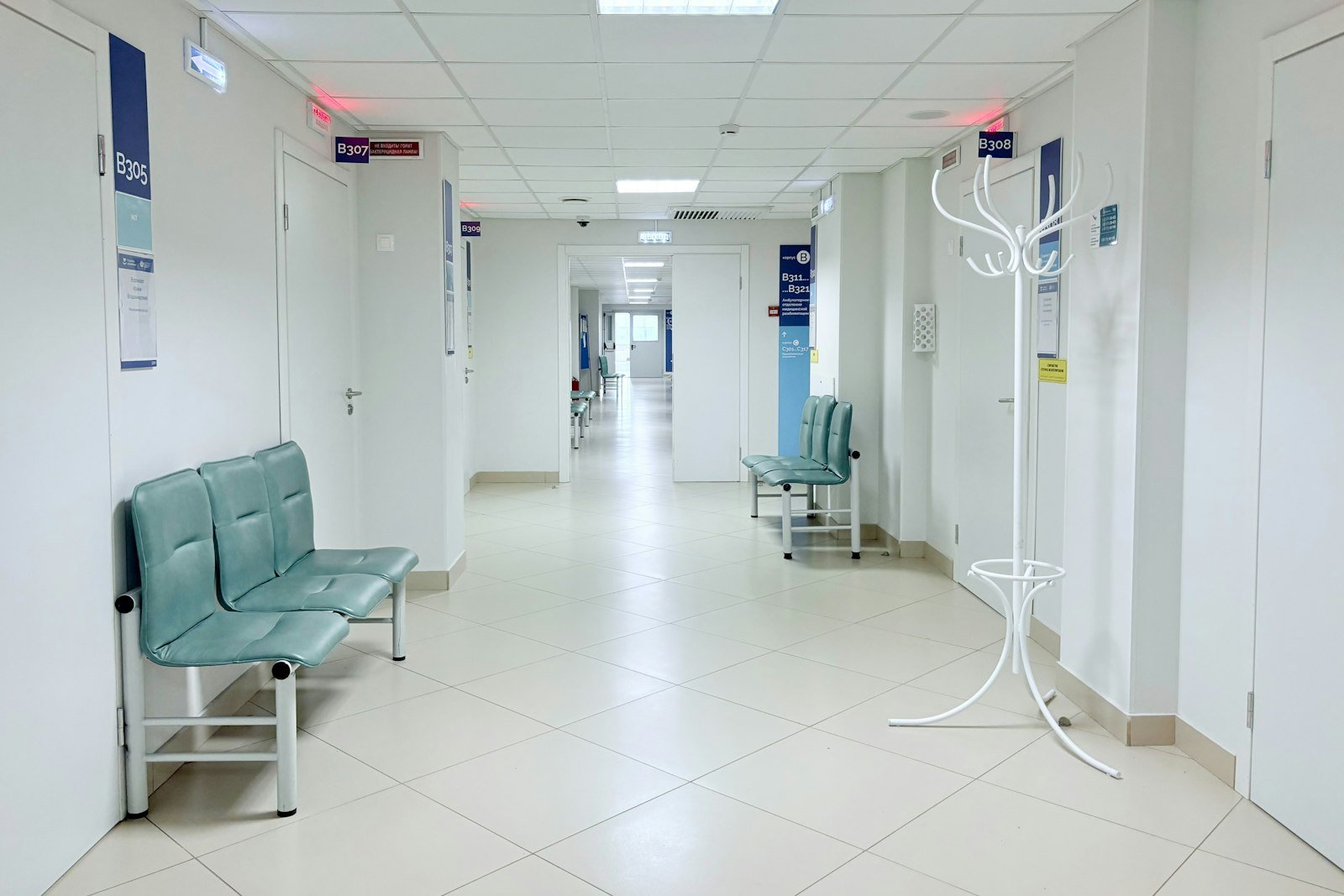
Hospitals that hold air, water and uptime in range.
Clinical spaces carry limits an ordinary building never sets. Aqueduct holds each room and outlet to its own and keeps the record surveyors ask for.
What hospitals and healthcare teams are up against.
Water, energy, air and operations carry equal weight. Each one runs the same loop: monitor, measure, identify, act, verify.
Water: Hot water loops and low use outlets
Stagnant outlets and cool loops, logged on a weekly round
Energy: Chillers, boilers and AHUs
Plant run flat out so no ward ever complains
Air: Theaters and isolation rooms
Pressure and air changes drifting between validations
Operations: Central plant
Faults found only when a theater drifts out of range
Problem, solution, impact.
How Aqueduct resolves each problem for hospitals and healthcare, and what changes when it does.
Stagnant outlets and cool loops, logged on a weekly round
A live water balance across meters and sub-meters localizes the loss, routes the fix and confirms it closed at the meter.
Loss found from the balance, not the bill, and every fix verified.
Plant run flat out so no ward ever complains
Weather-normalized baselines per building and asset show the waste in money; schedules and setpoints adjust where control is enabled.
Savings stated in money and confirmed at the meter, not estimated.
Pressure and air changes drifting between validations
Air quality per zone, overlaid with occupancy, with ventilation raised when it matters and verified back in range.
Targets held during occupied hours, with the energy cost counted.
Faults found only when a theater drifts out of range
Faults diagnosed in plain language and routed into your CMMS with the fix; early signs of failure schedule maintenance first.
Fewer reactive call-outs and closures confirmed by the equipment.
One incident, from first signal to verified fix.
An illustrative example of the flywheel on a typical site.
Theater, ward and plant points read from the BMS.
Limits per room class, taken from your protocol.
Isolation room 4 losing negative pressure.
Ticket to engineering naming the exhaust fan.
Pressure restored. Breach log kept for the survey.
Four connected products on one data layer.
Replace what should be replaced. Connect the rest.
- BMS and BAS
- EMS
- Indoor air quality monitoring
- Outlet temperature logging
- CMMS
- EAM
- Nurse-call and clinical systems stay separate
Three equal ways in: keep your BMS, replace it, or build Aqueduct in at design stage.
The questions each seat asks first.
“Does it fix things or just flag them?”
“Can I show continuous records for water and air?”
“Is the saving measured or estimated?”
Standards and regulations we supply evidence for.
We supply the measured inputs. You run the program and file the report.
Why hospital plant is different.
of US commercial building energy goes to health care buildings, on 4% of the floor space.
Source: EIA CBECS, health carepeople who catch Legionnaires’ disease during a healthcare stay die.
Source: CDC, Legionnaires diseaserise in reported US legionellosis from 2000 to 2014, as cited by CMS.
Source: CMS memo QSO-17-30, 2017What surveyors and standards ask for.
| Rule or standard | Date | What it asks for |
|---|---|---|
| CMS water management expectation | Since June 2017 | A Legionella risk assessment and a water management program |
| ASHRAE 188 | First published 2015 | Minimum legionellosis risk management for building water systems |
| Joint Commission PE.04.01.05 | From 1 January 2026 | Water management program, now in the Physical Environment chapter |
| ASHRAE 170 | 2025 edition available | Pressure, air changes, temperature and humidity by room type; your authority sets the edition |
New references, the same evidence.
A new chapter for surveys
Hospital surveys from 2026 cite PE references instead of EC ones. Records keyed to rooms and outlets carry across without rework.
NHS net zero for direct emissions
NHS England targets net zero by 2040 for emissions it controls, and estates are the largest part of them.
Proven in live sites.
Anonymized results from live sites.
in one of India’s top hospital chains
Features that matter here
Common questions
No. Aqueduct holds the limits your own protocol sets, whether they come from ASHRAE 170, NABH aligned values or hospital policy. Each room class gets its own range, and every change to a limit is logged with who made it, so surveyors can see which values applied on any date. See ASHRAE 170.
No. Aqueduct measures air, water and power in clinical spaces and stays out of clinical IT. Patient records, nurse call, bedside monitors and medical devices remain on their own networks, so adding Aqueduct does not change clinical system validation or the scope of patient data.
Aqueduct logs hot and cold water temperatures at the control points in your water management program and compares each reading with its acceptable range. Every excursion is kept with the work order that fixed it, which is the evidence PE.04.01.05 asks for. See Joint Commission PE.
Yes, where outlets or branches carry flow or temperature sensors. Aqueduct lists outlets with no use over the period your risk assessment sets and hot water legs that cool below range, so flushing goes where it is needed instead of to every tap on a round. See ASHRAE 188.
Yes, by starting where risk is lowest. Aqueduct baselines central plant, offices and non-clinical zones on weather and finds chillers, boilers and air handlers working harder than needed. Critical rooms can stay read-only, with their limits watched rather than changed. See HVAC energy optimization.
See Aqueduct on your own facility.
Bring a site, a utility bill or a question. We will show you where the loss is.