Best facility management software for FM service providers
 Milvian AI teamFacilities and infrastructure intelligence
An FM provider needs software that finds faults before the client does and proves the contract was delivered. It must work across every client's systems without forcing a rip and replace.
Why providers need their own layer
An integrated FM provider runs dozens of client sites, each with its own BMS, meters and CMMS rules. The contract is judged on response times and uptime, but the provider usually learns about a fault when a client calls.
Labor is the constraint. The US Bureau of Labor Statistics projects about 40,600 openings a year for HVACR mechanics from 2025 to 2035. LBNL's study of 60,000 pieces of HVAC equipment found 40 percent of air handlers and 30 percent of terminal units showed a reported fault on any given day, more than any team can chase without ranking them.
What the software must do
| Requirement | Why it matters here | Ask the vendor |
|---|---|---|
| Read each client's systems. | Providers cannot replace client controls to win a contract. | How many of our clients' BMS brands can you read? |
| Rank faults by cost. | Technician hours go to what matters most. | Can faults carry an estimated cost per day? |
| Feed the client's CMMS. | Work orders must land where the client tracks them. | Which CMMS products do you integrate with? |
| Prove SLA delivery. | Renewals depend on evidence. | Can you report response times and conditions by site? |
| Separate client data. | Each client sees only its own sites. | How is access partitioned between clients? |
Contracts are shifting toward outcomes
More FM contracts now carry energy, water or comfort targets alongside response times. Proving them needs a baseline the client accepts. DOE's Smart Energy Analytics Campaign reported median savings of 9 percent from fault detection and diagnostics, with one to two year paybacks, the kind of figure a provider can build a shared-savings clause around.
Predictive work changes the economics too. DOE FEMP reports that predictive maintenance saves 8 to 12 percent over preventive.
How to evaluate one
- Pick two client sitesChoose different BMS brands and sectors.
- Connect the CMMSSend a diagnosed fault into the client's work order system.
- Build the SLA reportProduce a month of response and condition data for one client.
- Price a shared-savings offerUse the baseline to model an outcome clause.
Where Aqueduct fits
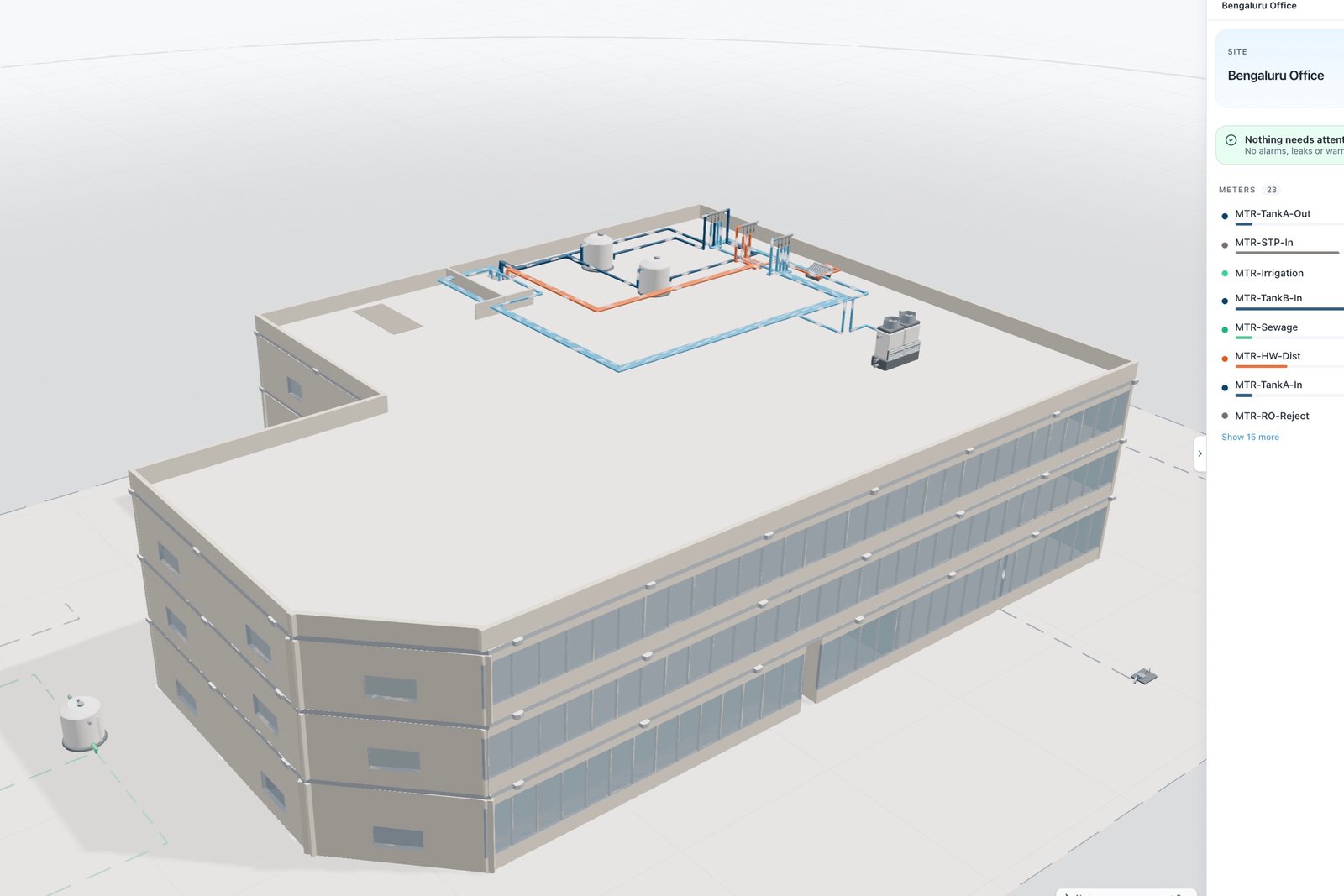
Aqueduct gives a provider one portfolio view across client sites, with each client partitioned. It reads client controllers, raises diagnosed faults into the client's CMMS, and tracks setpoint attainment and comfort compliance per site. Weather-normalized baselines in aQ EnergySmart and aQ WaterGuard give both sides an agreed method for outcome clauses. Device health shows which sensor needs attention before a site visit.
Sources
| Source | Link |
|---|---|
| US BLS, Occupational Outlook, HVACR mechanics | bls.gov |
| LBNL, Crowe and Granderson et al., 2023 | bies.lbl.gov |
| US DOE, Smart Energy Analytics Campaign | energy.gov |
| US DOE FEMP, O&M Best Practices Guide R3.0 | energy.gov |